
CEO Group Is Set to Break Ground on Its First Industrial Park in the Hai Phong Free Trade Zone
CEO Group and Hai Phong city are expected to break ground on the Tien Lang Airport Industrial Park – Zone B Project (CEOZone Hai Phong) on January 15 in Chan Hung commune, Hai Phong city.rnrnThis is one of the first industrial park projects to be implemented within the Hai Phong Free Trade Zone (FTZ) – the first free trade zone model in Northern Vietnam and currently the most comprehensive FTZ model in the country.
The selection of CEO Group to implement one of the first projects in the Hai Phong Free Trade Zone (FTZ) not only demonstrates the Group’s strong capability and credibility, but also positions it as a pioneer in translating a new institutional model into tangible projects on the ground.
Tien Lang Airport Industrial Park – Zone B covers an area of 186.49 hectares, with a total investment of nearly VND 2,800 billion. The project is developed by C.E.O Industrial Park Development Joint Stock Company (CEO IP), a member of CEO Group, as the project investor. The project is oriented toward a next-generation industrial park model: Green – Smart – Sustainable, prioritizing the attraction of high-tech industries with low emissions, high added value, and strong environmental friendliness.
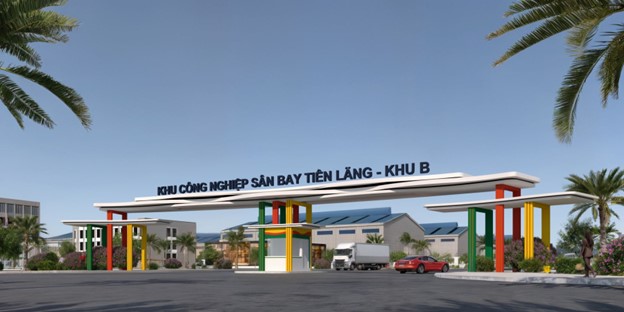
Tien Lang Airport Industrial Park – Zone B is one of the first projects to be implemented within the Hai Phong Free Trade Zone.
With a “backbone” location in the Northern industrial–logistics network, the project is positioned along the Ninh Binh – Hung Yen – Hai Phong – Quang Ninh coastal expressway, close to Nam Do Son deep-water port and adjacent to the planned Tien Lang International Airport, creating a rare “one point – five connections” advantage: road, railway, air, inland waterway and maritime transport.
Notably, being fully located within the Southern Hai Phong Economic Zone and the Hai Phong Free Trade Zone enables CEOZone Hai Phong to benefit from a dual advantage in both infrastructure and institutional framework. Preferential policies on procedures, taxation, customs clearance, talent attraction and R&D incentives position the project as an attractive destination for high-tech, low-emission and high value-added investors, amid the ongoing restructuring of global supply chains.
The Hai Phong Free Trade Zone is being developed as a new institutional space, where Vietnam is piloting a development approach based on capital quality, technological intensity, value chains and innovation, rather than low-cost investment attraction. The FTZ offers a comprehensive set of superior incentives, including streamlined investment procedures, automated customs, long-term tax incentives, international talent attraction, and strong encouragement for R&D, high-tech industries and clean manufacturing.

CEO Group targets the development of 500–1,000 hectares of next-generation industrial parks in the coming period
In its development strategy, CEO Group identifies next-generation industrial park infrastructure as a long-term growth pillar, alongside Real Estate, Construction and Services. CEOZone Hai Phong serves as the first project in the Group’s strategy to develop 500–1,000 hectares of next-generation industrial parks in the coming period.
According to Dr. Doan Van Binh, Chairman of the Board of Directors of CEO Group, once fully operational, the project is expected to attract approximately USD 1.5 billion in secondary investment capital, create around 20,000 jobs for the local workforce, increase state budget revenues, and promote the development of an integrated industrial – logistics – urban ecosystem in the southern area of the port city, thereby making a substantive contribution to the socio-economic development of Hai Phong.
This is one of the projects receiving special attention and priority from Hai Phong city, aimed at anticipating the global supply chain shift and forming a new growth engine alongside traditional development corridors such as Dinh Vu – Cat Hai and VSIP – Thuy Nguyen. The project has also been identified as a key initiative in celebration of the 14th National Congress of the Communist Party of Vietnam.
The upcoming groundbreaking of CEOZone Hai Phong is not only an important investment milestone for CEO Group, but also a critical first step in bringing the Hai Phong Free Trade Zone into practical realization, contributing to the shaping of a new industrial development model for Vietnam—one that emphasizes quality, sustainability, and deep integration into global value chains.