The Deputy General Director of CEO Group joined the online exchange in respect of “Social houses – the opportunities for the poor” on VTC News
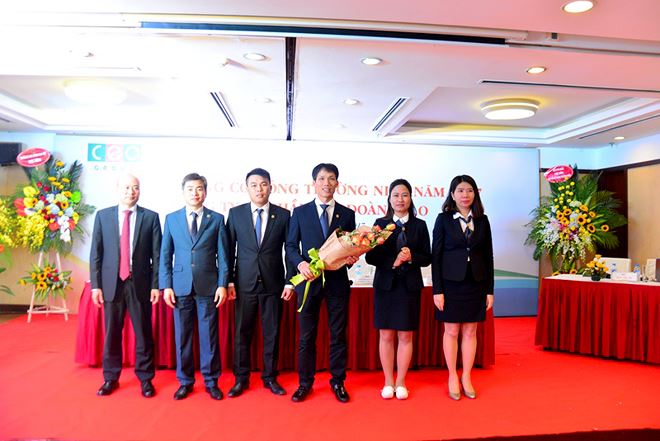
At the invitation of VTC News Electronic Newspaper House, in the morning of 20 August 2013, Mr. Ta Van To – Deputy General Director of CEO Group, together with Deputy Minister of Construction Nguyen Tran Nam and Prof. Dang Hung Vo, joined the online exchange to response to resident’s inquiries on issues relating to social houses.
Following are the contents of the online exchange:

Deputy Minister Nguyen Tran Nam received nearly 100 social houses-related questions from the readers
Tran Minh Tuan: Too much focus on low-income houses will result in redundancy in the next 2-3 years. At that time, the illegal transfer may arise. What measures shall the Ministry of Construction take in case of violations?
Deputy Minister Nguyen Tran Nam: Firstly, according to the investigations of the Ministry of Construction and Construction Departments of cities and provinces, there is a large demand for low-income houses at present.
For example, there are about 1,750,000 people encountering housing difficulties in urban areas, while the number of workers in industrial areas having demand for residential houses is approximately 1.7 million, especially in HCMC and Hanoi city.
Generally, the number of social houses needed is about 110,000 units in Hanoi, 134,000 units in HCMC, 104,000 units in Binh Duong, and 95,000 in Dong Nai. Meanwhile, in Hanoi, for example; the total number of social housing projects is about 15,000 units. Basically, the difficulty is the lack of supply source. The Ministry of Construction and the authorities at all levels are now concentrating on solving difficulties in procedures to promote the growth in the supply source of social houses. As a result, the redundancy is unlikely to happen.
According to current regulations, free transaction of social houses can only carried out after 10 years, and 5 years in the coming time. Those who illegally transfer will be handled in accordance with the law.
Tuan Dang: The representative of the State Bank said that the disbursement depended entirely on housing supply source in the market, the money at the bank’s side has always been ready, the problem only lies in lack of commodities, i.e. the supply source of affordable houses with small area. The number of social houses is still very limited. Therefore, is it the fault of the Ministry of Construction for the difficulties of people in owning cheap houses in the fastest way? What measures has the Ministry taken to promoting sources of commodities?
Deputy Minister Nguyen Tran Nam: As I mentioned above, the key issue is to focus on increasing the supply source. At present, the supply source is still limited, and the procedures to start social housing projects are now facing obstacles. However, after 5 months since the Circular No. 02 of the Ministry of Construction guiding the conversion of residential houses into social houses came into force, the Ministry of Construction has introduced up to 59 projects to the bank, among which, however, only one project can get bank loan.
So, what needs to be focused on is that the Ministry of Construction and the State Bank must cooperate more closely to better promote the disbursement progress to enterprises and make favorable conditions for them to initiate and accomplish the construction of foundation to be able to sign the contract.
In the light of this, I would like to provide more information regarding this matter. According to the latest figure, by 13 August, the State Bank has disbursed the total amount of 49 billion dongs to 208 individual households under the loan package of 30,000 billion dongs.
In comparison with the number of 19 customers disbursed with 3.46 billion dongs until June 30, this figure has increased day after day.
We hope that, when some projects are eligible for sale, the disbursed loan amount will significantly increase in the fourth quarter of this year.
Dong Binh (Khanh Hoa): Good morning Deputy Prime Minister, in Khanh Hoa, there still exists the segment of residential houses invested for construction under Decree No. 71/2001/ND-CP on investment incentives for construction of residential houses for sale and for rent (often called houses under preferential treatment policy). Although Decree No. 71/2011 has been invalid, the province has asked the Prime Minister to allow a reserved number of projects and continue to implement this policy. Currently, the investor is organizing the sale for the objects under preferential treatment policy approved by the PPC at the capital preservation price of not exceeding 9 million dongs/1m2 of floor.
So, my questions for you are:
1/ Is the aforesaid housing segment is social housing?
2/ Are customers that buy such houses entitled to get benefits from the credit package of 30 trillion dongs?
Deputy Minister Nguyen Tran Nam: First of all, Decree No. 71/2001/ND-CP remains in effect, and the information you have provided is not sufficient for me to answer. If these projects were invested for construction by the state budget funds, their sale will not be allowed, rather than for rent or hire- purchase. If these projects were built by non-state budget funds, they are in the form of low-income houses, also known as social houses, and the people that are entitled to social houses purchase are also entitled to the loan package of 30,000 billion dongs.
dongthu8687@gmail.com (Tran Dong): Deputy Minister, currently I am working in a state agency. I am subject to the payroll. But I have no permanent residential registration book in Hanoi, which makes it difficult for me to access social housing purchase and the credit package of 30 trillion dongs. Why does not the Ministry of Construction direct the sale of social houses to state agencies that can guarantee or help their staff in purchase of houses? Thank you Deputy Minister!
Deputy Minister Nguyen Tran Nam: According to the regulations, people that are entitled to social housing purchase must first have permanent residential registration. In the absence of permanent residential registration, you must have a temporary residential registration, together with the condition that you have paid social insurance within a period of at least 12 months in the area.
So far, the Ministry of Construction has conducted a survey on the demands and organized the registration for social house purchase in the Central ministries, sections, branches situated in Hanoi and will hold direct contact between the representatives of such Central ministries, sections, branches with investors of social housing projects in the area to register the purchase as per unit with supports.
In fact, The Ministry of Construction introduced a social housing project to the Ministry of Justice last August, and 20 staff of the Ministry of Justice has been approved for purchase of social houses.
Luu Van Dat: So far 50 commercial housing projects have been registered to transfer to social housing. Could you publish such approved projects since many of them have been sold to customers under commercial housing purchase and sale contracts before conversion.
Deputy Minister Nguyen Tran Nam: At present, there are more than 50 projects, not only 50 as you said. The list of commercial houses converted into social houses has been published on the website of the Ministry of Construction and Construction Departments of provinces. We are going to register this list on the Construction Newspaper.
The conditions required for commercial housing projects to be converted into social housing projects include: no capital mobilization has been conducted, no sale to customers has been carried out, and in case of having sold to customers, a written consent of all customers is required.
So it will be illegal if the investor fails to get customers’ consent.
It is the Ministry of Construction that introduces policies, not directly make examinations and evaluations for licensing, which belong to the responsibilities of localities.
Hoang Hai Yen: At the present, many real estate enterprises including us are not qualified enough to access to the 30,000 billion dong preferential loan package. I’m afraid that if this situation is not resolved soon, the policy will fall into deadlock because no construction means no house for people to buy. So what methods has the Ministry of Construction worked out for the capital access?
Deputy Minister Nguyen Tran Nam: Up till now, the Ministry of Construction has made 2 lists in accordance with Circulars No. 7 and No. 11 of the State Bank
The Ministry of Construction will introduce the approved investors to the State Bank and authorized commercial banks. By 09 August, the Ministry of Construction has introduced 2 lists including 59 enterprises that have social housing projects in many provinces and cities nationwide, in different forms and structures: State enterprises, private enterprises, joint stock enterprises…
The total proposed loan capital is over 5,000 billion dongs.
So far, according to the information I have received, the State Bank has just certified the loan capital for 2 enterprises in Ho Chi Minh City and Hue, of which the loan capital has been disbursed to only 1 enterprise.
Therefore, it is the bank that evaluates the specific effectiveness of projects, and the capabilities, repayment plans of enterprise to make its own lending decisions.
According to the bank’s report, in August, the bank is now positively examining so that by the end of August, there will be enterprises approved and disbursed.
At the side of enterprises, they need to thoroughly study circulars and regulations to prepare a good dossier to persuade the bank to lend them money. At the same time, the Ministry of Construction will coordinate with the State Bank to establish a working group to urge the bank and enterprises, handle their difficulties in the process of examination and lending.
Tran Van Huu: Could you please reveal how many enterprises have been approved in the list sent to the bank for capital loan in the 30,000 billion package? What are the special conditions (if any) for approving enterprises in the list of capital loan?
Deputy Minister Nguyen Tran Nam: The conditions for approval of the loan-borrowing application are as follows: The Ministry of Construction will examine the legality of company’s dossiers and prestige basing on 3 criteria: First, the approved low-income housing projects; second, clean and cleared sit; third, received decision on land assignment of competent authorities .
Tran Hanh: Currently, it is the mortgaged assets that cause difficulties for enterprises in borrowing money, what measures has the Ministry taken to solve this problem as the lending examination of the banks applied to real estate enterprises is of so many procedures?
Deputy Minister Nguyen Tran Nam: Firstly, the mortgage conditions for borrowing money from the bank are specified in the credit law, which requires enterprises to have mortgage when applying for bank loans.
To address this problem, we have suggested that enterprises can use their assets originating from loan capital to be the mortgage, however; the land use rights of state-owned enterprises are now posing a big obstacle.
Since the State collects no fee, enterprise will meet difficulties in mortgaging such assets.
On the other hand, if enterprises mortgage their land-based assets, the borrowers will, in turn, not be able to mortgage such assets to buy house.
To get this problem addressed, Deputy Prime Minister Hoang Trung Hai, Head of Central Steering Committee on Housing Policy and Real Estate Market has assigned the Ministry of Justice in collaboration with the Ministry of Construction and the State Bank to discuss and work out solutions to guide banks and enterprises.
However, to implement business projects, including social housing business, enterprises must also meet certain requirements of financial capability, especially the capital source.
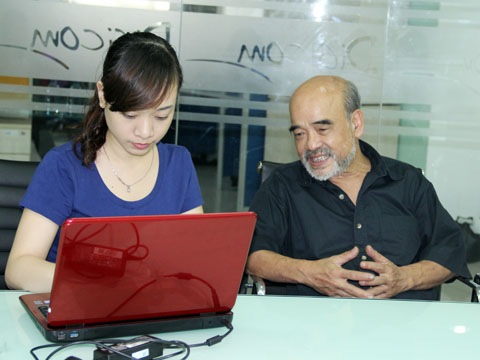
Prof. Dang Hung Vo answered the reader’s questions
Hoai Phuong (Mo Lao, Ha Dong, Hanoi): In your opinion, is the bank interest rate of 6% applied to houses buyers reasonable?
Prof. Dang Hung Vo: For low-income people in Vietnam, it is a preferential interest rate. But in many other countries around the world, they have their own funds for lending low-income people with a lower interest rate.
Tran Thi Van (Tan Binh, HCMC): What is your prediction about the excessive supply source of low income houses in the next 2-3 years? What will be the consequences?
Prof. Dang Hung Vo: We are now fallen into the excessive supply source in the areas of high and medium price residential houses, thus many people are concerned about the excessive supply source for social houses. Of course, it is highly possible that the supply source will exceed the necessary demands for social houses but not in the near future. Because currently, we are in shortage of supply source for social houses.
To overcome the excessive supply in the future, we need a system giving strict statistical analysis, predictions on the supply and demand relationship.
Nguyen Ngoc Tu (Soc Son, Hanoi): Professor, at present I and my husband have the total income of about 9 million dongs/month, belonging to low-income class. We often save only 500,000 dongs at maximum per month. So with the price of 500-700 million dongs for an apartment, we will never afford to buy one. In your opinion, is it possible for low-income people to buy one? And how can the poor own an accommodation in Hanoi?
Prof. Dang Hung Vo: 9 million dongs per month means about 100 million dongs per year. The previous ratio between the median house price and the yearly average income in Vietnam was about 25 times. If one person saved 25% of his/her income, he/she would only afford to buy a house in the next 100 years. This is the biggest paradox of real estate prices in Vietnam. According to this calculation, it is certain that every employee will only buy a house after his/her death no matter how much he/she is thrifty.
In your situation, if the calculated price of a house is 500 million dongs, your income is 100 million dongs/year, then this ratio is 5, which is much higher than the above-mentioned ratio. So what you need is to save as much money as possible to buy one soon.
If you save 1 million dongs per month, then after more than 40 years you can also buy one. Of course, low-income people need assistances from many sides such as relatives, friends… to be able to buy a house sooner.
Thuy Linh (Gia Lam, Hanoi): Now many enterprises are applying for conversion of their projects into social housing, in your opinion, is it because that they want to take advantage of the capital source from the 30.000 billion dong package?
Prof. Dang Hung Vo: There is no doubt that enterprises in construction, real estate business areas are now facing a big pressure on capital. Although commercial banks have reduced the interest rate, it is still not suitable for the construction and real estate business.
In the stagnant situation of the market now, it will be an advantage if investors can access to low-interest capital sources. So it is easy to understand if investors convert commercial housing projects into social ones.
The profit may be lower than that of commercial housing projects, but they have capital advantages. Therefore, most investors now desire to convert their projects into social ones.
Housing is always a great concern of the whole society, especially for working people, cadres and civil servants. Therefore, state management agencies have paid special attention to the issue of social housing development in order to create accommodations for people under the preferential treatment policy, cadres and civil servants, low-income employees, workers and students.
Dinh Tung: I am an office employee, my salary is 6 million dongs per month, so is it possible for me to buy a house in Hanoi, Deputy Minister?
Deputy Minister Nguyen Tran Nam: First, to solve the housing problem, we must have many solutions and many different product packages to serve different classes and objects in the society.
For low-income housing, we have a very wide range of area from 30 to 70m2 with prices depending on the location and position ranging from 6-12 million dongs/m2. Specifically, in Hanoi, we have a number of projects costing from 8 to 8.5 million dongs/m2 with the apartment area of 30.2 m2. The price of an apartment is about 250 million dongs. If you have counterpart capital of 50 million dongs, you can apply for a bank loan of 200 million dongs.
For a loan of 200 million dongs, you must pay 20 million dongs each year, 1.6 million dongs each month and 1 million dongs of interest rate in the first months. Thus, you must pay 2.6 million dong a month in the first months.
If your salary is 6 million dongs a month and you live alone, it is totally possible for you to buy an apartment of 30m2.
In this case, since your loan principal gradually reduces in the following months, the monthly interest also reduces accordingly. Wish you save as much money as you can to buy your own house and get married soon.
Also, for those with lower salary, the Government will have mechanisms and policies to promote the development of rental housing. At that time, we can rent houses to live.
The policy is to strongly develop rental housing in the future. It will take decades, not a short period of time for Vietnam to address the housing difficulties.
Pham Hai Thanh (Cau Giay, Hanoi): In the public opinion, the regulation on “the customer must prove their repayment ability” poses a very big barrier for workers with instable income. So in your opinion, should the State Bank replace it by a more flexible binding?
Professor Dang Hung Vo: This opinion is totally true. If the banks lend money to the poor, the mechanism requiring them to prove their repayment ability cannot be applied. In other countries, they use a completely different mechanism for the poor to borrow money. Moreover, they also have banks specializing in lending the poor money, and the poor can still pay the bank debt while the banks can still get profits.
A specific example is that a bank owner in Bangladesh specializing in lending the poor money has used the poor community mechanism in mutual supports and supervision in the loan use as well as the loan repayment. And the only thing the bank needs to do is to maintain a good relationship with the community. In Vietnam, similar mechanisms are needed; the lending mechanisms for the rich people should not be applied to the poor.
Ngoc Anh (Phu Tho): Professor, at the present, prices of low-income houses range from 10-12 million dong/ m2, as compared with commercial houses, these prices are only slightly lower while the procedures are of great complexity. So according to you what are attracting points of low-income houses?
Professor Dang Hung Vo: In principle, the prices of social houses must always be lower than those of commercial houses with the same quality and infrastructure conditions. But in many localities in Vietnam, the prices of social houses are even higher than those of commercial houses under the same conditions. This can be attributed to the fact that the management mechanism for social houses exists many elements that are similar to the subsidy period, which is not close to the laws of value and competition of the market whereas the prices of commercial houses always tends to decrease due to fierce competitions among investors.
I hope Vietnam will also have certain changes in the price management mechanism for social houses to match price fluctuations in the market.
Tuan (Thanh Xuan District, Hanoi): Currently, despite great demands for social houses, in fact the social houses in many projects remain unsold. According to you, what are the problems?
Professor Dang Hung Vo: The main problem in Hanoi is the fact that the prices of some social houses are even higher than those of commercial houses in the same quality and living conditions. As a result, many people that have sufficient conditions to buy social houses do not want to buy as they believe that such prices are so high. Of course we will wait for the changes in the price management of social houses so that people are really entitled to the state preferences through the access to social houses.
Lan Anh (Dong Da District, Hanoi): Many social housing projects have been initiated in recent time. In your opinion, will the excessive supply happen? What are the reasons for the price differences among social apartment projects?
Could you please give information on the eligible subjects as well as procedures for social house purchase?
Professor Dang Hung Vo: Of course, the housing prices also depend on the quality and the location, which is an indispensable principle of housing. More detailed explanations can only be given if specific locations and specific differences are clearly pointed out.
People that are eligible for social house rental and purchase include: State cadres and public servants, workers of industrial parks, low-income people in urban areas. For low-income groups in urban areas, it must be certified that their income are really low and the area of their residential houses are unqualified, or they have no residential houses.
The Ministry of Construction has issued very detailed guidance on the dossiers and procedures.

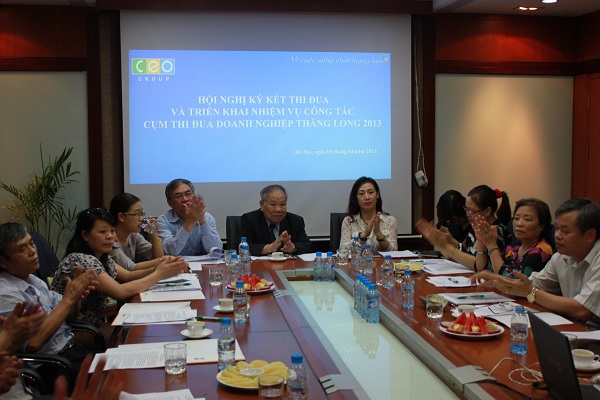
Mr. Ta Van To – Deputy General Director of CEO Group participated in questioning – answering online exchange
Do Y An (Thach That, Ha Tay): Could you please tell us when will the Social house project at Sunny Garden City new urban area, Quoc Oai, Hanoi be officially commenced? When is it expected to be completed?
Mr. Ta Van To – Deputy General Director of CEO Group: First of all, thank you for your interest in the project of CEO Group. We are actively promoting the legal procedures of the project. It is expected to be officially started in the 4th Quarter of 2013 and completed in 2015.
Cao Vu Nhat (Hai Duong): What is the selling price of social housing projects in Sunny Garden City new urban, Quoc Oai, Hanoi? Has this project started to receive the registration dossiers yet?
Mr. Ta Van To – Deputy General Director of CEO Group: It is expected that the selling price will be less than 10 million dongs/ m2 including VAT. After the project is eligible for sale, approximately in the end of the 4th quarter of 2013 or at the beginning of the year 2014, we will receive registration dossiers from customers.
Mai Lan (HCMC): One of my friends has bought a social house in Quoc Oai. I find that its location is quite good, and the entire project was previously the commercial housing project. So why did the investor convert this into social housing project? Was it because that the company had difficulties in capital source?
Mr. Ta Van To – Deputy General Director of CEO Group: We decided to convert the purposes of use of CC1 land lot at Sunny Garden City project into social housing with the following objectives:
– Help ensure the social security through partially meeting the demands for social houses of cadres, public servant, people with low incomes in the area of Hanoi, which is an important step in accomplishing the Project to attract people to live in this urban area.
– Respond to the spirit of Resolution No. 2/NQ-CP dated 07 January 2013 of the Government in respect of some solutions to address business – production difficulties, support the market, and settle bad debts. Help create jobs for workers. Take advantages of the State incentives.
– Create products that are suitable to the market demands. Our company is now not having difficulties in capital source.
Bac Ha (Thuy Nguyen, Hai Phong): In addition to projects in Quoc Oai, will CEO convert or build any new social housing projects in the coming time?
Mr. Ta Van To – Deputy General Director of CEO Group: In the short term, Group CEO will only focus on social housing projects in Quoc Oai, in the future we will be able to continue the research on the implementation of social houses in other projects of the company.
Ha Thuy (preschool teacher in Dong Da district, Hanoi): I have learnt that this is the first time CEO Group builds social houses. I read in the newspaper previously that many people complained about little profits or no profit gained in construction and business of social houses. So is this direction too risky? Or did CEO Group start with this to gain preferences from the 30,000 billion dong package?
Mr. Ta Van To – Deputy General Director of CEO Group: For social housing projects, as stated above, we do not put profit targets on the top of priorities because we direct towards the following targets: Help ensure the social security; create jobs for workers; at the same time help accomplishing the Project to attract people to live in this urban area.
Linh Thu (HCMC): How many apartments will the social project in Quoc Oai offer after completion? Who are eligible to buy house in this project? And what are incentives for customers from the 30,000 billion dong package?
Mr. Ta Van To – Deputy General Director of CEO Group: The social housing project has an area of 10.528m2 of land, belonging to the population of 24.4 hectares of Sunny Garden City new urban area. It is expected to provide 400-500 apartments with the area from 30m2 to 70m2/apartment after completion; the objects that are eligible to buy social houses are specified in Decree No. 34/CP dated 22 April 2013; the incentives for customers from the 30,000 billion dong package are specified in Circular No. 07/BXD dated 15 May 2013 of Ministry of Construction and Circular No. 11/NHNH dated 15 May 2013 of the State Bank. You can find more information on websites.
Bui Ngoc Tung (Me Linh District, Hanoi): Currently many low-income housing projects in Hanoi and HCMC are encountering difficulties in selling. As a representative of the enterprise, in your opinion what is the biggest problem during the implementation of the sale?
Mr. Ta Van To – Deputy General Director of CEO Group: In our opinion, to promote the sale, it is necessary to convince customers of two things: first, the quality of social houses is as good as that of commercial houses; second, the cheap price of social houses does not mean low quality, but it is due to preferential policies gained in accordance with the regulations (in terms of land use tax, preferential loans, VAT, enterprise income tax …).
Moreover, the Investor must apply technologies, technical solutions and select suitable materials, facilities and equipments to have the most reasonable price while can still offer full of utilities to customers.
For CEO Group’s project, as it is located in the entire urban area, the Investor has calculated right from the time of changing partial adjustment planning, design, and operation and management work in the future to create the harmonious connectivity to more than 300 surrounding villas, aiming at bringing the best environment to the residents.
Le Minh Hieu: What is your opinion about the conversion of commercial housing projects in social ones nowadays? Will an excessive supply for social houses occur in the next few years?
Mr. Ta Van To – Deputy General Director of CEO Group: In my opinion, it is very necessary to build social houses at the moment and in the future because there is still a big demand for them. According to the review by the Ministry of Construction, at present and by 2015, about 1.74 million people will face housing difficulties (with the average accommodation area of under 5m2) and approximately more than 1.7 million workers have demands for stable housing.
To meet such urgent demands, we need to build about 700,000 apartments. According to the forecast by Ministry of Construction, the housing demands of workers in Industrial Parks will increase by about 200,000 apartments.
Therefore, in the coming years, in our opinion, the excessive supply of social houses is unlikely to happen.
Do Duc Bao: At present, the prices of social houses and commercial ones are nearly equal. So what are the competitive advantages of social houses?
Mr. Ta Van To – Deputy General Director of CEO Group: As you said, the price of commercial houses in recent time has been considerably reduced in all market segments, however; so far, according to our evaluation, the house prices are unlikely to be further decreased. At the present, the price difference between commercial houses and social houses ranges between 3-5 million dongs/m2, so the social houses still have competitive advantages over the commercial ones
Lan Anh (Gia Lam District, Hanoi): The social houses in many areas are now being degraded, so is the cheap price attributed to the non-assured quality of such works?
Mr. Ta Van To – Deputy General Director of CEO Group: According to our information and in fact, social housing areas all over the country have basically received positive feedbacks from customers so far in terms of quality (for example: Vinaconex Xuan Mai, Viglacera social housing areas …). And the reasons that the price of social houses is cheaper than commercial ones were stated in my answering to Bui Ngoc Tung’s question.
Mai Hue (Quoc Oai, Ha Tay): Your enterprise will hardly gain profits from and face difficulties in selling social houses, why do you still want to invest in this project? In the coming time, will CEO Group implement new projects?
Mr. Ta Van To – Deputy General Director of CEO Group: As answered above, our objectives for implementing this social housing project are to help ensure the social security; create jobs for workers; at the same time help accomplishing the Project to attract people to live in the urban area.
Ngo Lam (Bac Ninh): Will CEO Group be one of enterprises receiving supports from the 30,000 billion dong package? If supported, how much will CEO receive?
Mr. Ta Van To – Deputy General Director of CEO Group: As an enterprise implementing social projects, we are entitled to receive supports from the 30,000 billion dong package. However, we are in process of completing legal documents of the Project, so the specific figure has not been agreed upon.
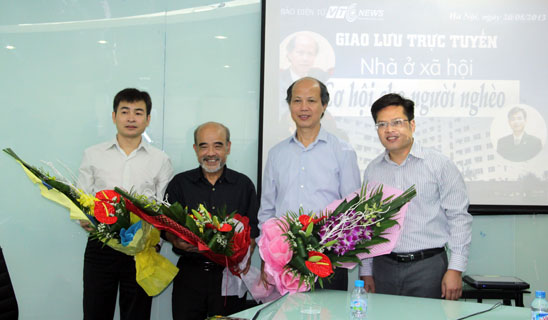
Mr. Ta Van To and the invited guests participated in online exchange to respond to all the questions of people about social house.
(Source: VTC News)